Institutional Architecture
How ATI Turns Strategy Into Strong Institutions
Strategy does not execute itself. ATI routes policy, intelligence and practical delivery through an integrated institutional architecture designed to close the gap between high-level strategy and field reality.
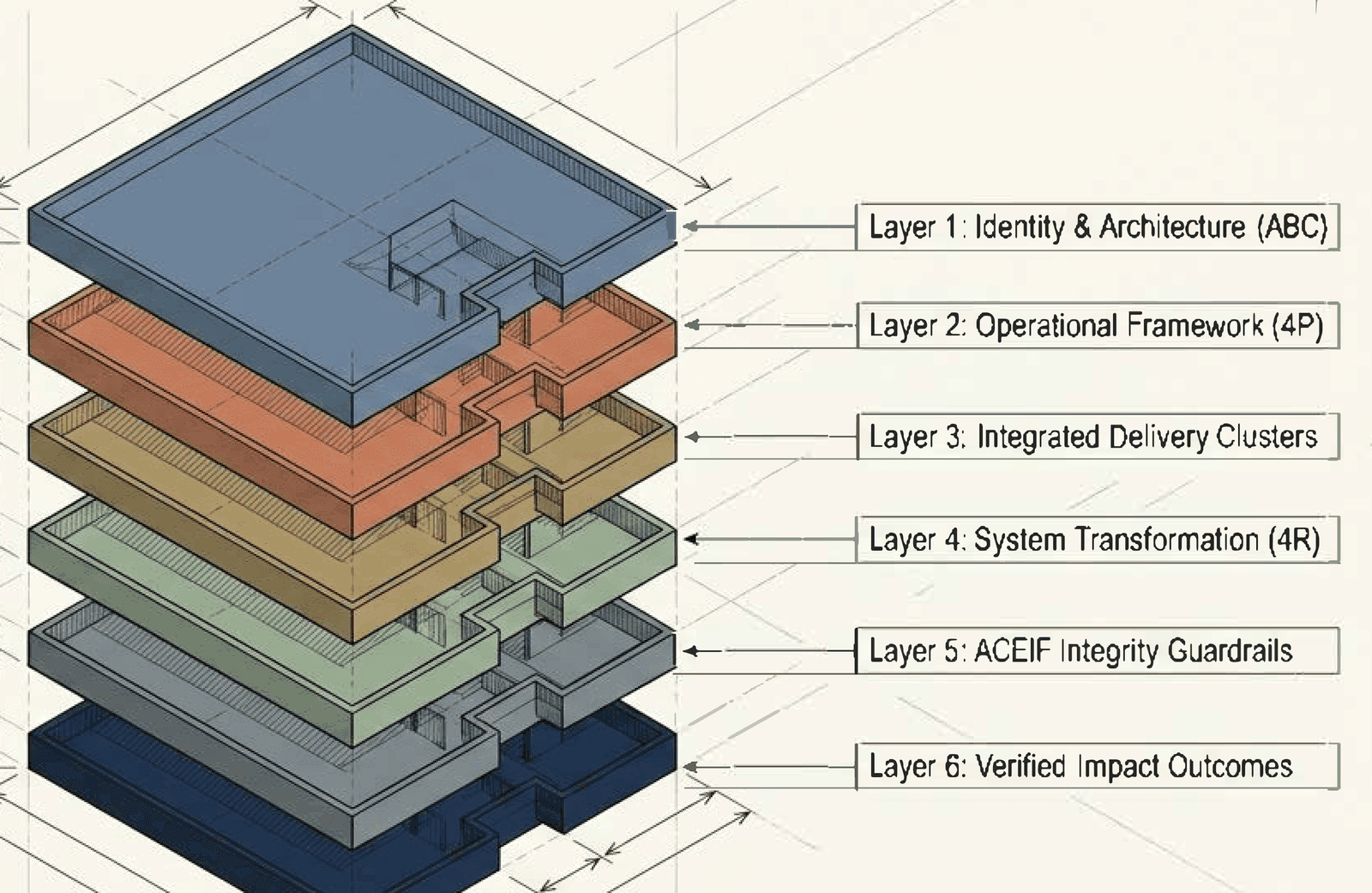
- 01 Identity & Architecture (ABC)
- 02 Operational Framework (4P)
- 03 Integrated Delivery Clusters
- 04 System Transformation (4R)
- 05 ACEIF Integrity Guardrails
- 06 Verified Impact Outcomes
The problem it solves
The Implementation Gap
Traditional approach
- Conservation
- Governance
- Security
ATI integrated approach
- Conservation
- Governance
- Security
The institutional blueprint
Six Layers. One Institutional Machine.
Identity & Architecture (ABC)
Architecture, Bridger and Catalyst together define ATI's institutional identity before any activity begins: the deliberate design of integrated systems, the function of connecting policy to field execution, and the engine that scales the response.
Operational Framework (4P)
The confirmed operating principles are Pursue (intelligence-led action and targeted interventions against identified threats) and Protect (safeguarding critical natural assets and the systems that sustain them).
Integrated Delivery Clusters
Security & Governance strengthens structural oversight and physical security. Resilience & Restoration is focused on the active restoration of degraded natural and institutional systems.
System Transformation (4R)
The confirmed transformation principles are Resilience (engineering the capacity of environmental and governance systems to absorb, withstand and recover from systemic shocks) and Restoration (moving beyond preservation toward the active repair and renewal of degraded natural and institutional assets).
ACEIF Integrity Guardrails
The Anti-Corruption and Environmental Integrity Framework governs every layer above through Prevention, Transparency, Evidence-Based Governance and Accountability.
Verified Impact Outcomes
The ultimate goal is not activity for its own sake, but strong institutions. ATI measures progress through institutional permanence and verified results that demonstrate whether the architecture is securing Africa's natural wealth.
Layer 1: Identity & Architecture
Identity Before Activity
Architecture
The deliberate design of integrated institutional systems, moving beyond isolated and temporary programmes.
Bridger
The critical function of connecting high-level strategy and policy directly to practical, effective field execution.
Catalyst
A high-output engine that accelerates and scales integrated responses.
Layers 2 & 3: Operational Framework and Delivery Clusters
From Intelligence-Led Action to Permanent Delivery
The 4P operational framework
Pursue
Intelligence-led action and targeted interventions against identified threats.
Protect
Safeguarding critical natural assets and the systems that sustain them.
Integrated delivery clusters
Security & Governance
Strengthening structural oversight and physical security.
Resilience & Restoration
Focused on the active restoration of degraded natural and institutional systems.
Security & Governance
Structured training iterations
ATI's law-enforcement work is delivered as repeated, documented training iterations rather than one-off events. The maritime wildlife trafficking series alone ran at least six documented iterations between 2022 and 2023, across venues in Mombasa, Arusha and Dar es Salaam, before the March 2025 investigative techniques and port security training brought in officers from Malawi and Zambia.
Each iteration combines classroom instruction with practical, scenario-based exercises. Cohorts are multi-country by design: wildlife trafficking crosses borders, so the officers trained to interrupt it train together.
Security & Governance
Controlled-delivery methodology
Controlled delivery is a law-enforcement training methodology in which a monitored consignment is allowed to proceed under surveillance so that trafficking networks, not just couriers, can be identified. ATI delivered three documented controlled-delivery practical exercises in 2023: Dar es Salaam in May, Mombasa in June and Arusha in October.
This page describes the methodology at the level appropriate for institutional readers. Operational detail that could compromise enforcement work is deliberately not published.
Resilience & Restoration
Community programming
Community work follows the same practice: dated events, named partners, documented delivery. Where a programme involves survivors or vulnerable people, ATI describes its own role and activity. It does not narrate any individual's experience without direct, attributed, consenting words.
Resilience & Restoration
Institutional policy engagement
Since 2025, ATI has worked at the policy layer in Zanzibar: co-financing the Situational Analysis Report 2025 and the Zanzibar Unified Strategy for Natural Resources Security and Resilience 2026–2036 with the Ministry of Agriculture, Irrigation, Natural Resources and Livestock, and convening multi-agency training for government participant institutions.
Layer 4: System Transformation
Building Systems That Absorb Shock and Recover
Resilience
Engineering the capacity of environmental and governance systems to absorb, withstand and recover from systemic shocks.
Restoration
Moving beyond preservation toward the active repair and renewal of degraded natural and institutional assets.
Layer 5: ACEIF Integrity Guardrails
Integrity Is Structural
Prevention
Proactive structural measures designed to stop corruption before it enters the system.
Transparency
Openness in field operations and data flow.
Evidence-Based Governance
Institutional honesty and rigor supported by strictly verified data.
Accountability
Clear and unambiguous responsibility for operational outcomes.
The Outcome: Strong Institutions
The ultimate goal is not activity for its own sake, but strong institutions. ATI measures progress through institutional permanence and verified results that demonstrate whether the architecture is securing Africa's natural wealth.
Institutional Roles and Accountability
ATI designs systems, strengthens capacity and supports coordinated delivery. Statutory investigative, arrest, prosecutorial and operational authority remains with the responsible public institutions.
The Chairman's role
Leadership in Practice
The method in practice
Practical field exercise during the controlled delivery course, Mombasa, Kenya, 12–17 June 2023. Training venue, controlled delivery course, Serena Beach Hotel, Mombasa, Kenya, June 2023. Session under the Lusaka Agreement Task Force banner reading “Agreement on Cooperative Enforcement Operations Directed at Illegal Trade in Wild Fauna and Flora.”
Request a briefing
Institutions considering a programme with ATI can request a direct technical briefing with our team.